--Custody of minors--Male children was handed over to father, who was a civil servant and even educated person--

 PLJ 2009 Lahore 356 

Constitution of Pakistan, 1973—


----Art. 199--Constitutional petition--Custody of minors--Male children was handed over to father, who was a civil servant and even educated person--Application for custody to extent of the male children was accepted--Appeal was dismissed--Challenged through writ petition--Right of custody for male minors who are above 7 years--Validity--Question raised through writ petition is that change of custody from mother to father shall change the scenario, and would damage the future of minors--Held: Civil servant being an educated person will not care for future of his minor sons for whom he was much concerned all along--Right of custody for male minors who are above 7 for father is to be preferred as he is in a better position to facilitate and arrange schooling--No illegality or infirmity calling for interference in exercise of Constitutional jurisdiction of High Court--Petition was dismissed.      [P. 358] A

Mr. Muhammad Sana Ullah Khan, Advocate for Petitioner.

Date of hearing: 22.1.2009.


 PLJ 2009 Lahore 356
Present: S. Ali Hassan Rizvi, J.
KOUSAR PERVEEN alias SHAMEEM--Petitioner
versus
MUHAMMAD FAYYAZ and 2 others--Respondents
W.P. No. 1068 of 2009, decided on 22.1.2009.


Order

The petitioner is aggrieved of the judgment of the learned trial Court dated 14.07.2008 whereby the custody of the minors male children was handed over to Respondent No. 1 and the dismissal of the appeal on 22.11.2008, there-against.

2.  Brief facts of the present case are; that the petitioner was married with Respondent No. 1 and out of the wedlock five children were born. Respondent No. 1 filed an application seeking custody of four children, namely, Mst. Ishrat Fatime, (12), Naeem Sultan, (11), Saleem Sultan, (09), and Waseem Sultan, (07) on the ground that petitioner-respondent left his house and a suit for restitution of conjugal rights was pending. The minors were studying in Sun Rise English Medium School. Their future was at stake on account of removal of minors from his custody by the mother, therefore, it was in the welfare of the minors to grant him their custody. The petitioner filed written reply and raised a preliminary objection that the petition was filed in order to avoid the maintenance allowance; that in fact the respondent had beaten her and turned out from his house and that it was in the welfare of the minors if custody remained with her. The learned trial Court framed the following issues out of pleadings of the parties:

(i)   Whether the applicant is entitled for the custody of the minors as Welfare of minors lies with him? OPA

(ii)  Whether the application/suit is false and frivolous and same has been filed just to avoid the payment of maintenance allowance? OPR

(iii) Relief.

After recording evidence, learned Guardian Judge/trial Court decided Issue No. 1 and held that Respondent No. 1 was a civil servant and even educated person. The custody of female child Mst. Ishrat Fatime was declined while for the male minors who were above 7, was given to the respondent observing that it was in the welfare of the minors if custody was given to Respondent No. 1. Resultantly, the application of the respondent for custody to the extent of the male children Naeem Sultan, Saleem Sultan and Waseem Sultan was accepted. The petitioner filed an appeal which was dismissed, hence, this writ petition.

3.  Learned counsel for the petitioner has alleged that the minors are getting education in a school and change of custody shall jeopardize their future. In his view, change of educational institution is sufficient ground as in the circumstances the minors shall suffer with a set back, qua their education, which is supreme.

4.  Heard. Respondent No. 1 as PW1 in his main petition has alleged that male minors Naeem Sultan, Saleem Sultan and Waseem Sultan were student of Sun Rise Public School when they were taken away by the petitioner and their future was put to winds.

5.  Perusal of the record reveals that there is no rebuttal of the above version. A suit for restitution of conjugal rights is also pending. The admitted fact is that Respondent No. 1 is a civil servant and an educated one. The male minors all are above 7.  They were studying in Sun Rise Public School at the time of removal. The father deposed in his evidence as PW1 that he was worried about the future of the minors and intended to provide them better schooling and facilities. The basic consideration for the Guardian Judge remains and continues to be the welfare of the minors. The learned Guardian Judge after recording evidence was of the opinion that the welfare of the male minors lay in giving their custody to the respondent. The question raised through this petition is that change of custody from mother to father shall change the scenario, and would damage the future of minors. As far as appreciation of evidence is concerned, a different view cannot be taken that a civil servant being an educated person will not care for future of his minor sons for whom he was much concerned all along. The right of custody for male minors who are above 7 for father is to be preferred as he is in a better position to facilitate and arrange schooling. There is no illegality or infirmity calling for interference in the exercise of Constitutional jurisdiction of this Court. Dismissed.

(R.A.)      Petition dismissed.

-Purpose of enacting S.4 in Muslim Family Laws Ordinance, 1961, was to cater the need of grandchildren to remove their sufferings but this provision could not be interpreted in a manner affecting the shares of other descendants in the property in accordance with law of Shariah-

2005 SCMR 1595 

Law of Shariah was not overridden by S.4 of Muslim Family Laws Ordinance, 1961, and consequently the parties would not get more than their shares in the property in accordance with law of Shariah---Widows and daughters of predeceased son would get what they were entitled on the death of predeceased son, after opening of succession of father of the predeceased son---Purpose of enacting S.4 in Muslim Family Laws Ordinance, 1961, was to cater the need of grandchildren to remove their sufferings but this provision could not be interpreted in a manner affecting the shares of other descendants in the property in accordance with law of Shariah---Heirs of predeceased children, according to law of Shariah, would inherit what their father or mother would have inherited during their life time on the opening of succession.


Whether predeceased daughter’s legal heirs, who died before the promulgation of Muslim Family Laws Ordinance, 1961, are entitled to inherit the estate of their grandfather who died after the promulgation of “Ordinance 1961” in terms of section 4 of the Ordinance, 1961.?

Undeniably, under the Islamic Sharia, predeceased children are not entitled to any inheritance as only the survivors to a deceased are entitled to inheritance. In the year 1961, the Muslim Family Laws Ordinance, 1961 was promulgated on 15.07.1961 and was commenced after issuance of Notification which was published in PLD 1961 Central Statutes at Page 337, wherein section 4 was introduced, by virtue of which, legal heirs of pre-deceased son or daughter of propositus would be entitled to inheritance on re-opening of the succession.

There is no cavil with the proposition that section 4 of the Ordinance, 1961 has no retrospective effect.
The words “In the event of death of any son or daughter of propositus before the opening of succession” appearing in Section 4 of the Ordinance, 1961 are very important.
Grandchildren are entitled to receive share equal to the share of their mother or father in view of section 4 of the Ordinance, 1961 irrespective of the fact their mother or father died before or after the promulgation of the Ordinance, 1961 and the only condition is that the succession should be open after the promulgation of the Ordinance, 1961.
Therefore, there is no doubt in my mind that it is not the requirement of Section 4 of the Muslim Family Law Ordinance, 1961 that the occurrence of death of the son or daughter of propositus as well as opening of succession should both take place subsequent to the promulgation of the Ordinance, 1961. The only requirement of section is that succession should open after the Ordinance is brought into effect. Section 4 is made applicable when succession of propositus opens and it is an established principle of Muslim Law that the succession of a Muslim opens the moment he dies.
It is settled law that no limitation runs against a wrong entry, mutation is also not a starting point of limitation. In a matter of inheritance, the limitation does not preclude a person to get his share from inheritance.

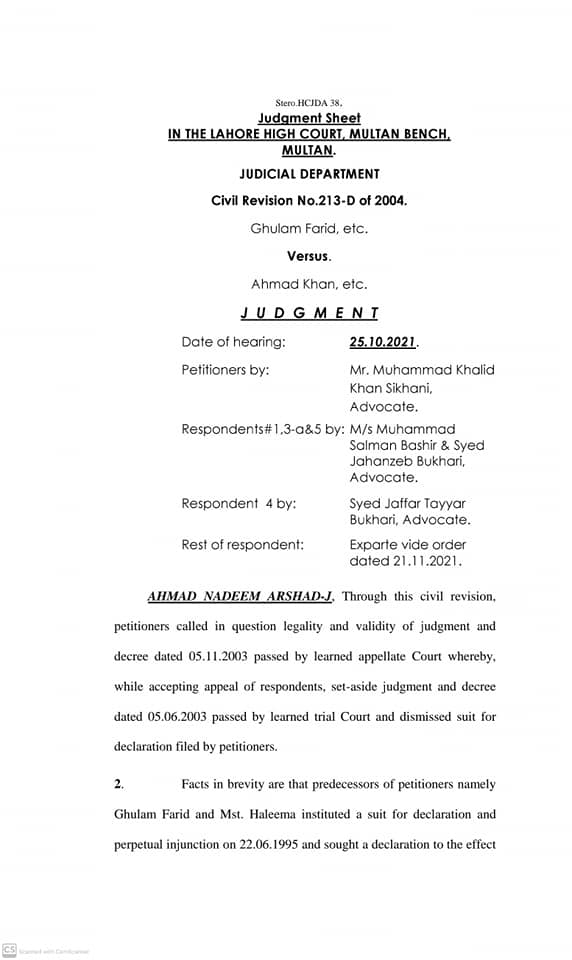
Civil Revision No.213-D of 2004.
Ghulam Farid, etc. Versus. Ahmad Khan, etc.


Whether predeceased daughter’s legal heirs, who died before the promulgation of Muslim Family Laws Ordinance, 1961, are entitled to inherit the estate of their grandfather who died after the promulgation of “Ordinance 1961” in terms of section 4 of the Ordinance, 1961.?

Undeniably, under the Islamic Sharia, predeceased children are not entitled to any inheritance as only the survivors to a deceased are entitled to inheritance. In the year 1961, the Muslim Family Laws Ordinance, 1961 was promulgated on 15.07.1961 and was commenced after issuance of Notification which was published in PLD 1961 Central Statutes at Page 337, wherein section 4 was introduced, by virtue of which, legal heirs of pre-deceased son or daughter of propositus would be entitled to inheritance on re-opening of the succession.

There is no cavil with the proposition that section 4 of the Ordinance, 1961 has no retrospective effect.
The words “In the event of death of any son or daughter of propositus before the opening of succession” appearing in Section 4 of the Ordinance, 1961 are very important.
Grandchildren are entitled to receive share equal to the share of their mother or father in view of section 4 of the Ordinance, 1961 irrespective of the fact their mother or father died before or after the promulgation of the Ordinance, 1961 and the only condition is that the succession should be open after the promulgation of the Ordinance, 1961.
Therefore, there is no doubt in my mind that it is not the requirement of Section 4 of the Muslim Family Law Ordinance, 1961 that the occurrence of death of the son or daughter of propositus as well as opening of succession should both take place subsequent to the promulgation of the Ordinance, 1961. The only requirement of section is that succession should open after the Ordinance is brought into effect. Section 4 is made applicable when succession of propositus opens and it is an established principle of Muslim Law that the succession of a Muslim opens the moment he dies.
It is settled law that no limitation runs against a wrong entry, mutation is also not a starting point of limitation. In a matter of inheritance, the limitation does not preclude a person to get his share from inheritance.

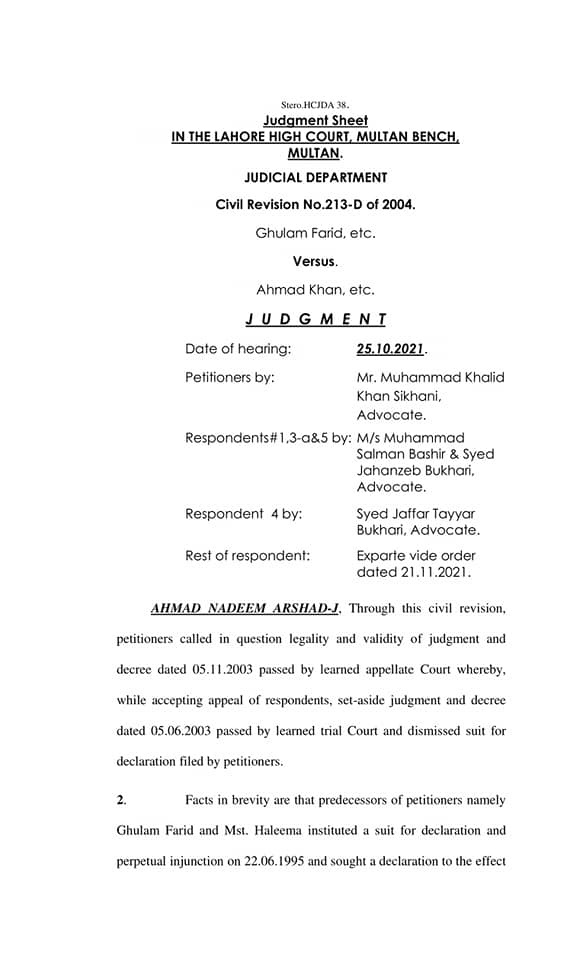
Civil Revision No.213-D of 2004.
Ghulam Farid, etc. Versus. Ahmad Khan, etc.


—Provisions of S. 48 C.P.C. cannot be pressed into service for execution of such decree, in that, S. 17 of Family Courts Act, 1964 postulates that C.P.C. except Sections 10 and 11 thereof, would not be applicable to proceedings before Family Court-As for limitation, reliance has to be placed on residuary Art. 181 of Limitation Act which provides period of three years when right to apply accrues-

 PLJ 2001 SC 288 [Appellate Jurisdiction]

Family Courts Act, 1964 (XXXV of 1964)--

—S. 5 & Sched-Constitution of Pakistan (1973), Art. 185(3)-Decree for recovery of prompt dower against petition or execution proceeding-Plea  of petitioner that execution proceedings were time barred was repelled by trial Court-Appellate Court accepting time barred plea set aside execution proceedings-High Court restored order of Executing Court- Validity-Decree for recovery of dower would be deemed to be in respect of prompt dower in as much as, tie off marriage existed between the parties—Provisions of S. 48 C.P.C. cannot be pressed into service for execution of such decree, in that, S. 17 of Family Courts Act, 1964 postulates that C.P.C. except Sections 10 and 11 thereof, would not be applicable to proceedings before Family Court-As for limitation, reliance has to be placed on residuary Art. 181 of Limitation Act which provides period of three years when right to apply accrues-Nature of liability being of prompt dower, recognition of which has been made judicially by  Family Court in favour of respondent, the same has to be recovered during subsistence of marriage, therefore, no specified period of limitation for implementation of decree of such nature can be fixed in as much as, due to subsistence of marriage, no specific period of limitation for implementation of such decree can be fixed for the reason that due to subsistence of marriage, judgment debtor i.e., husband, having acknowledged right of his wife would be deemed to remain under legal obligation to satisfy decree whenever decree holder/wife moves legal forum for satisfaction of her right-As and when proceedings of execution were launched that date would be treated as denial by judgment debtor to satisfy liability of prompt dower and execution proceedings for the recovery of the same would be considered within time as per requirement, of Art. 181 of Limitation Act, 1908-No interference was thus, called for in impugned judgment passed by the High Court-Leave
to appeal was refused in circumstances.                                   [P. 290] A

Mr. Basharatullah, Sr. ASC and Mr. Mehta W.N. Kohli, AOR for Petitioner.


Nemo for Respondents. Date of hearing; 1.11.2000.


 PLJ 2001 SC 288 [Appellate Jurisdiction]
Present: IFTIKHAR MUHAMMAD CHAUDHRY AND DEEDAR HUSSAIN SHAH, JJ. Syed MUHAMMAD-Petitioner
versus
Mst. ZEENAT and others-Respondents C.P. No. 134-Q of 1998, decided on 1.11.2000.
(On appeal from the judgment dated 23.6.1998 of the High Court of Balochistan, Quetta passed in Constitutional Petition No. 284 of 1999)


ORDER

Iftikhar Muhammad Chaudhry, J.-Petitioner seeks leave to appeal against judgment dated 23rd June 1998 passed by High Court of Balochistan whereby Constitutional Petition No. 284 of 1997 filed by Respondent No. 1 was allowed and as a consequence whereof the order of executing Court/Family Judge dated 22nd February 1997 was restored.

2.          Succinctly stating facts of the case are that petitioner and private  respondent are related to each other as husband and wife. The tie of marriage also exist between them. The Respondent No. 1 obtained a decree for recovery of prompt dower against the petitioner from the Court of Family Judge Turbat as back as on 24th October 1979. However, proceedings for execution of decree were filed by her on 10th November 1996. Petitioner raised objection on execution of the decree being barred by time. Learned executing Court vide order dated 27.2.1997 over-ruled the objection and directed the petitioner to satisfy the decree. Feeling aggrieved from said order petitioner preferred appeal which came  up for hearing before Additional District Judge, Turbat who vide order dated IQth June 1997 accepted the same, as a consequence whereof execution application of private respondent was  dismissed.  Under  the circumstances a Constitutional Petition was filed by respondent which has been allowed vide impugned judgment by a Division Bench in Chambers of High Court of Balochistan.

3.          Learned counsel contended that execution application filed by respondent on 10th November 1996 for execution of decree dated 24th October 1979 was hopelessly barred by time, therefore, Additional District Judge/Appellate Court has rightly set aside order of executing Court dated 27.2.1997 but learned Division Bench in Chambers of High Court of Balochistan without taking into consideration that under Section 48 CPC a maximum period of 6 years for execution of decree has been prescribed and any such application submitted beyond the prescribed period shall not be entertained because due to lapse of time the decree became in-executable.

4.    We have heard learned counsel for petitioner at length and have also examined the impugned order carefully. At the outset it may be noted that respondent while instituting Constitutional petition, challenged order dated 10.6.1997 mainly on two scores, firstly the appeal filed by petitioner against order of executing Court dated 27.2.1997 was not maintainable under Section 14 of the Family Courts Act, 1964; and secondly no period has been prescribed for recovery or dower under the Limitation Act because during subsistence of marriage recurring cause of action accrues to decree holder to recovery the dower. Learned High Court decided former question against the respondent holding that appeal was competent against order of the executing Court in terms of Section 14 of the Family Courts Act, 1964, therefore, this aspect of the case needs no further consideration because in instant petition competency of appeal against an order passed by executing Court is not open to challenge as far as petitioner is concerned.

5. In respect of latter question, however, it was held that decree of dower cannot be refused to be executed being barred by limitation. Therefore, we would cotifine ourselves only to this aspect of the case. According to Article 103 of Limitation Act all suits for the decree of prompt dower can be instituted within three years from its demand whereas time prescribed for the suit of deferred dower is three years under Article 104 of ihe Limitation Act. In the instant case as tie of marriage exists between the parties, therefore, decree dated 24th October 1979 for recovery of dower would be deemed to be in respect of her prompt dower which consists of both the money as well as the property. Now the question for consideration is that what should be the period of limitation for filing of execution application for satisfaction of prompt dower. As far as Section 48 CPC is concerned its provisions cannot be pressed into service because under Section 17 of the Family Courts Act, 1964 Code of Civil Procedure, 1908 except its Sections 10 and 11 is not applicable to proceedings before any Family Court. As far as Limitation Act is concerned under its Article 182 period for execution of a decree of any Civil Court has been prescribed to be three years but in our opinion as the1 Family Court is not a civil Court stricto senso, therefore, the provisions of this Article can also not be pressed into service. Thus reliance lias to be placed on the residuary article i.e. Article 181 of the Limitation Act, which provides the period of three years when the right to apply accrues. As it has been noted hereinabove that nature of the liability is of prompt dower, recognition of which has been made judicially by a Family Court in favour of respondent because the prompt dower is to be recovered during subsistence of marriage, therefore, no specific period of limitation for implementation of decree of such nature can be fixed because due to subsistence of marriage the judgment-debtor i.e. the husband acknowledges the right of his wife and lie is deemed to remain under a legal obligation to satisfy the decree whenever the decree-holder/wife has moved the legal forum for satisfaction of her right. This proposition can be considered from another angle i.e. that as tie of marriage exists between parties, therefore, the wife/decree-holder out of number of considerations may have postponed the implementation of the decree including the consideration that let relations between the spouses remain cordial or the husband is looking after her as well as other family members or the husband on account of his poor financial position is not in a position to implement the decree but such postponement for any consideration during subsistence of marriage would not deprive the decree-holder (wife) from execution of the decree being barred by time and no sooner proceedings of execution are launched that date would be treated as a denial by the judgment-debtor to satisfy the liability o prompt dower and execution proceedings shall be considered within time as per requirement of Article 181 of Limitation Act Thus for the above reasons no interference is called for in the impugned judgment passed by learned High Court of Balochistan.

The petition is dismissed and leave to appeal is refused.
(A.A.J.S.)                                                                               Leave refused.


Family matter Case Laws

2021 CLC 374 P. 17-A.Wife entitled to maintenance
2021 CLC 348 p. Unregistered nikah name or deed is genuine.
2021 YLR 108. Not cross examined on special matter is admi
2021 MLD 337. 17-A
2020 old lay 160. Christian divorce on basis of cruelty
2021 MLD peshawar 109
Family Court Act.1964.Sec.5.
Sched..
Suit for maintenance allowance,etc.
Wife with held best evidence which was available with her and made her claims doubtful by virtue of this she lost some claims,
Therefore High court modified judgments of the lower court
2020 PLD 269 SUPREME-COURTBookmark this Case
FAWAD ISHAQ VS Mst. MEHREEN MANSOOR
S. 5, Sched.---Transfer of Property Act (IV of 1882), S. 41---dower (mehr), recovery of---Property mentioned in Cl.16 of Nikahnama as dower for wife---suit for recovery of said property was filed by respondent-lady against her motherin-law and father-in-law without impleading her husband---Subject property was owned by the mother-in-law---Held, that mother-in-law was not a signatory to the Nikahnama nor had executed any other document agreeing to transfer the subject property---Mother-in-law had not permitted her husband, expressly or impliedly, to transfer the property in terms of S.41 of the Transfer of Property Act, 1882---Respondent made no attempt to ascertain that the father-in-law had the power to transfer the property---suit filed by respondent was dismissed with the observation that she could still claim from her husband any part of her dower which remained unpaid.

اگر دولہا کے والد نے بوقت نکاح دولہا کے وکیل کے طور پر نکاح نامہ پر دستخط کیے ہوں یا انگوٹھا ثبت کیا ھو تو اس صورت میں وہ نکاح نامہ میں درج حق مہر اپنی بہو کو ادا کرنے کا پابند ہے

 اگر دولہا کے والد نے بوقت نکاح دولہا کے وکیل کے طور پر نکاح نامہ پر دستخط کیے ہوں یا انگوٹھا ثبت کیا ھو تو اس صورت میں وہ نکاح نامہ میں درج حق مہر اپنی بہو کو ادا کرنے کا پابند ہے

W.P No.5899 of 2020
(Muhammad Fayyaz, ete. Vs. Addl. District Judge, ete.)


Powered by Blogger.

Case Law Search