






Section 6 of the "Ordinance, 1961" places a restriction on the second marriage of husband unless he obtains prior permission in ......
2024 CLC 1170
WP 97-24
SONIA SHARIEF VS ADJ ETC
Mr. Justice Mirza Viqas Rauf
Section 6 of the "Ordinance, 1961" places a restriction on the second marriage of husband unless he obtains prior permission in writing of the Arbitration Council. Sub-section 5 of section 6 of the "Ordinance, 1961" provides consequences of contracting second marriage by a man without permission of Arbitration Council, one of which is that he has to face prosecution in complaint and if it is proved that he contracted second marriage without permission of the Arbitration Council, he shall be liable to be convicted and punishable with the simple imprisonment which may extend to one year and with fine of five hundred thousand rupees. The petitioner being wife of "respondent" lodged a complaint under section 6 of the "Ordinance, 1961" before the Senior Civil Judge (Family Division), Tehsil Sarai Alambir, District Gujrat through her special attorney Naveed Hanif s/o Muhammad Hanif, which was dismissed being not proceedable through attorney. "Ordinance, 1961" does not prescribe any procedure for the trial of the complaint, however, the Rules under the "Ordinance, 1961" (hereinafter referred to as "Rules, 1961") framed under section 11 pave way for the trial of offences under the "Ordinance, 1961". Needless to mention here that Rule 21 of the "Rules, 1961" ordains that no Court shall take cognizance of any offence under the Ordinance or these rules save on a complaint in writing by the Union Council, stating the fact constituting the offence. It would not be out of context to mention here that Rule 21 was later on reconstituted by the orders of the Governor of Punjab in exercise of powers conferred upon him by section 11 of the "Ordinance, 1961" through S.O X-1-15/75-Vol.II published in Gazette of Punjab, Extraordinary, 14th October, 1976 and words "aggrieved party" were inserted in place of "Union Council
Entry in column No.17 of the Nikahnama---Interpretation---Free consent and freedom of the bride to settle the terms of her Nikah Nama---Significance---Entitlement of divorced wife to immoveable property described in column 17........
2024 SCMR 1078
Entry in column No.17 of the Nikahnama---Interpretation---Free consent and freedom of the bride to settle the terms of her Nikah Nama---Significance---Entitlement of divorced wife to immoveable property described in column 17 of the Nikah Nama---Form of Nikah Nama nor its headings are conclusive or sacrosanct---It is the intent of the parties which would be the determining factor---In the present case the description of the plot in column 17 of the Nikah Nama is explicit and not disputed---However, there is no condition stipulated in the column except the description of the plot---Petitioner (husband) had filed his written statement in response to the plaint and had expressly admitted the description of the property but he had taken the stance that the plot was meant for the construction of a house and the respondent (wife) was to live in it for as long as the marriage subsisted---However, a plain reading of the description of the property, as mentioned in column 17, does not indicate nor supports such a stance---If such an interpretation is accepted then the property would not form part of the dower separately mentioned in columns 13 to 16 of the Nikah Nama---Copy of the Nikah Nama showed that no condition has been stipulated in column 17 except describing the property---It is not the case of the petitioner (husband) that the columns were filled by the respondent (wife) or pursuant to meaningful consultation carried out with her before or at the time of execution of the Nikah Nama---No such evidence was brought on record---Onus was on the petitioner (husband) to establish that the property described in column No. 17 was not meant nor intended by the parties to be part of the dower---Ambiguity, if any, cannot be construed against the interests and rights of the respondent (wife) in the facts and circumstances of the present case---Moreover, accepting the stance of the petitioner (husband) would amount to reading in the Nikah Nama something not provided therein----Courts cannot construe the Nikah Nama and its entries as having the effect of applying a stipulation not expressly provided therein---High Court had correctly interpreted the columns of the Nikah Nama and declared the respondent (wife) entitled to the plot described in column 17 of the Nikah Nama.
2024 SCMR 1078
MUHAMMAD YOUSAF vs HUMA SAEED
Dower (mehr)---Entries in columns of the Nikah Nama---Interpretation---Free consent of the bride and her freedom to settle the terms and conditions of the Nikah Nama---Significance--
Dower (mehr)---Entries in columns of the Nikah Nama---Interpretation---Free consent of the bride and her freedom to settle the terms and conditions of the Nikah Nama---Significance---Courts, while interpreting the contents and terms and conditions of a Nikah Nama, also have to take into consideration the factor of free consent of the bride and her freedom to settle the terms and conditions as a person having an informed understanding of her rights---This is crucial in the context of the social and cultural norms generally prevalent in the society---If an ambiguity or doubt arises in relation to the terms and conditions of the Nikah Nama, an entry or column thereof, then the benefit ought to go in favor of the wife if there does not exist preponderance of evidence on record to establish that she had been informed of her rights, she understood each column of the Nikah Nama, and she had the freedom to negotiate and settle the terms and conditions out of free consent---In case the columns of the Nikah Nama have been filled by others without her meaningful consultation then a doubt or ambiguity cannot be interpreted against her rights or interests---It is implicit in the expression ''free consent'' that the wife, at the time of executing the Nikah Nama, had the freedom to settle the terms and conditions as an informed person competent to enter into a contract---Paternal tendencies of the society and dominance of the male members in relation to deciding the terms and conditions on behalf of the bride has generally been accepted as a cultural and social norm of the society---It places a bride in a disadvantageous position, inevitably adversely affecting her capacity to execute the contract with free consent---Weakness or creation of an ambiguity in a Nikah Nama cannot be interpreted against the interest and rights of a wife if it cannot be established that she had the freedom to settle the terms and conditions and had exercised her free will.
2024 SCMR 1078
MUHAMMAD YOUSAF vs HUMA SAEED
Dower ( mehr ) --- Entries in columns of the Nikah Nama --- Interpretation --- Free ' consent of the bride and her freedom to settle the terms and conditions of the Nikah Nama --- Significance ---
2024 SCMR 1078
Dower ( mehr ) --- Entries in columns of the Nikah Nama --- Interpretation --- Free ' consent of the bride and her freedom to settle the terms and conditions of the Nikah Nama --- Significance --- Courts , while interpreting the contents and terms and conditions of a Nikah Nama , also have to take into consideration the factor of free consent of the bride and her freedom to settle the terms and conditions as a person having an informed understanding of her rights --- This is crucial in the context of the social and cultural norms generally prevalent in the society -- If an ambiguity or doubt arises in relation to the terms and conditions of the Nikah Nama , an entry or column thereof , then the benefit ought to go in favor of the wife if there does not exist preponderance of evidence on record to establish that she had been informed of her rights , she understood each column of the Nikah Nama , and she had the freedom to negotiate and settle the terms and conditions out of free consent --- In case the columns of the Nikah Nama have I doubt or ambiguity cannot be interpreted against her rights or been filled by others without her meaningful consultation then a interests --- It is implicit in the expression " free consent " that the wife , at the time of executing the Nikah Nama , had the freedom to settle the terms and conditions as an informed of the society and dominance of the male members in relation to person competent to enter into a contract --- Paternal tendencies deciding the terms and conditions on behalf of the bride has generally been accepted as a cultural and social norm of the inevitably adversely affecting her capacity to execute the society -- It places a bride in a disadvantageous position , contract with free consent --- Weakness or creation of at ambiguity in a Nikah Nama cannot be interpreted against the interest and rights of a wife if it cannot be established that she had the freedom to settle the terms and conditions and had exercised her free will .
C.P.L.A.2673/2022 Muhammad Yousaf v. Huma Saeed and others
2024 SCMR 1078
Family/Dissolution of Marriage on the Ground of Khulla .
2024 S C M R 634
With regard to the question raised before us by the petitioner as to whether Family Courts in Pakistan have jurisdiction to entertain the case when the plaintiff/wife is a dual citizen of Pakistan and the USA and is residing in the USA at the time of the institution of the suit, whereas, the husband is national and permanent resident of Pakistan. In this regard Rule 6 of the West Pakistan Family Courts Rules, 1965 is relevant .
In the above-proviso, the Legislature has intentionally used the word "ordinarily" which has a different meaning than that of permanent residence. According to Black’s Law Dictionary (VIth Edition) word "ordinary" means “usual, common, settled, customary, and reasonable”.
In the present case, although the Respondent is living in the USA at the time of the institution of the suit through her duly constituted attorney. However, the respondent usually comes to Pakistan; have acquired her education in Karachi and visits her family in Karachi from time to time.
By this proviso, the rigour of normal rule providing for territorial jurisdiction for trial of cases in Family Court have been relaxed in favour of female filing a suit for dissolution of marriage or recovery of dower. The words "Ordinarily resides" and "shall also have jurisdiction" used in proviso demonstrate the intention of parliament is to facilitate things for the wife and off-set her handicap. Therefore, the option of instituting such suits vests with the wife and the Court is bound to take her convenience subject to law. Hence, Family Courts in Pakistan have jurisdiction to entertain the matter and the trial court has rightly exercised so.
West Pakistan Family Courts Act, 1964 (“Act”) was promulgated for the expeditious settlement and disposal of disputes with regard to the marriage and other family affairs and also provides special procedure to achieve such object. Being special law, it creates the special courts for determination of the family disputes in order to advance justice and to avoid technicalities.
The Legislature while introducing amendment in the Family Court Act, 1964 has derived wisdom from Quran and Sunnah. Islam confers the right of Khula to woman by virtue of which a Muslim woman can get herself released from the bond of marriage if she feels, due to any reason, that she could not live with her husband within the limits prescribed by Allah Almighty. The right and mode of "Khula" has been described by Almighty Allah in verse No. 229 of Surah Baqra.
The proviso to section 10 empowers the Family Courts to pass a preliminary decree for the dissolution of Marriage forthwith upon the failure of reconciliation and further provides that wife shall be ordered to return the Haq Mehr received by her.
Section 10(3) imposes a legal obligation on the Family Courts to make a genuine attempt for reconciliation between the parties. Trial Court shall remain instrumental and make genuine efforts in resolving the dispute between the parties. In case if despite of genuine efforts, reconciliation fails, the Trial Court under proviso of section 10(4), without recording evidence is empowered to pass a decree of dissolution of marriage forthwith. At this juncture if the court observes that the wife without any reason is not willing to live with her husband, then under proviso (ibid) the Court is left with no option, but to dissolve the marriage.
عورت کے حق خلع پر وفاقی شرعی عدالت کا تازہ ترین انتہائی عالمانہ فیصلہ
PLD 2024 FSC 9
PLJ 2024 CrC 478
I) Whether the right of Khula is an absolute right of a woman in Islam and what are the requirements that are necessary to obtain Khula?
These are considered by scholars of Ahadith as the basic Ahadith that explain the legality of Khula as a right of women in the Islamic Law because it was granted to them by the Holy Prophet (SAW) when so demanded by the ladies in lieu of Mahar. The abovementioned Ayat No.229 of Surah Al-Baqarah and Ahadith give us some fundamental points of guidance necessary for a court of law to keep in mind while passing a decree and judgment of dissolution of marriage on the basis of Khula. These points are as follows:
Firstly, it is the fundamental right of a woman according to the injunctions of Islam as laid down in the Holy Quran and Sunnah to claim decree for dissolution of marriage from the court of law, which cannot be denied.
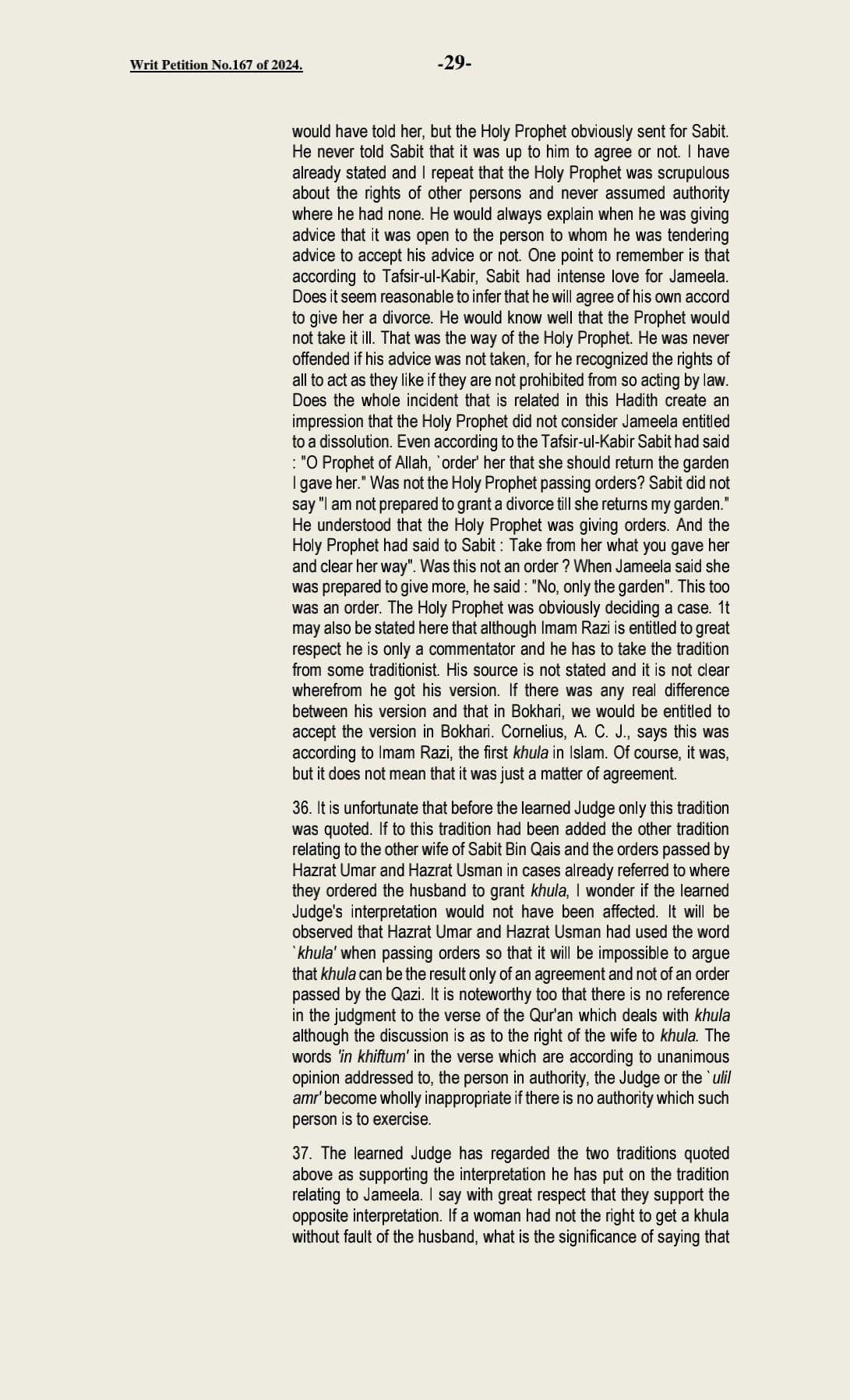
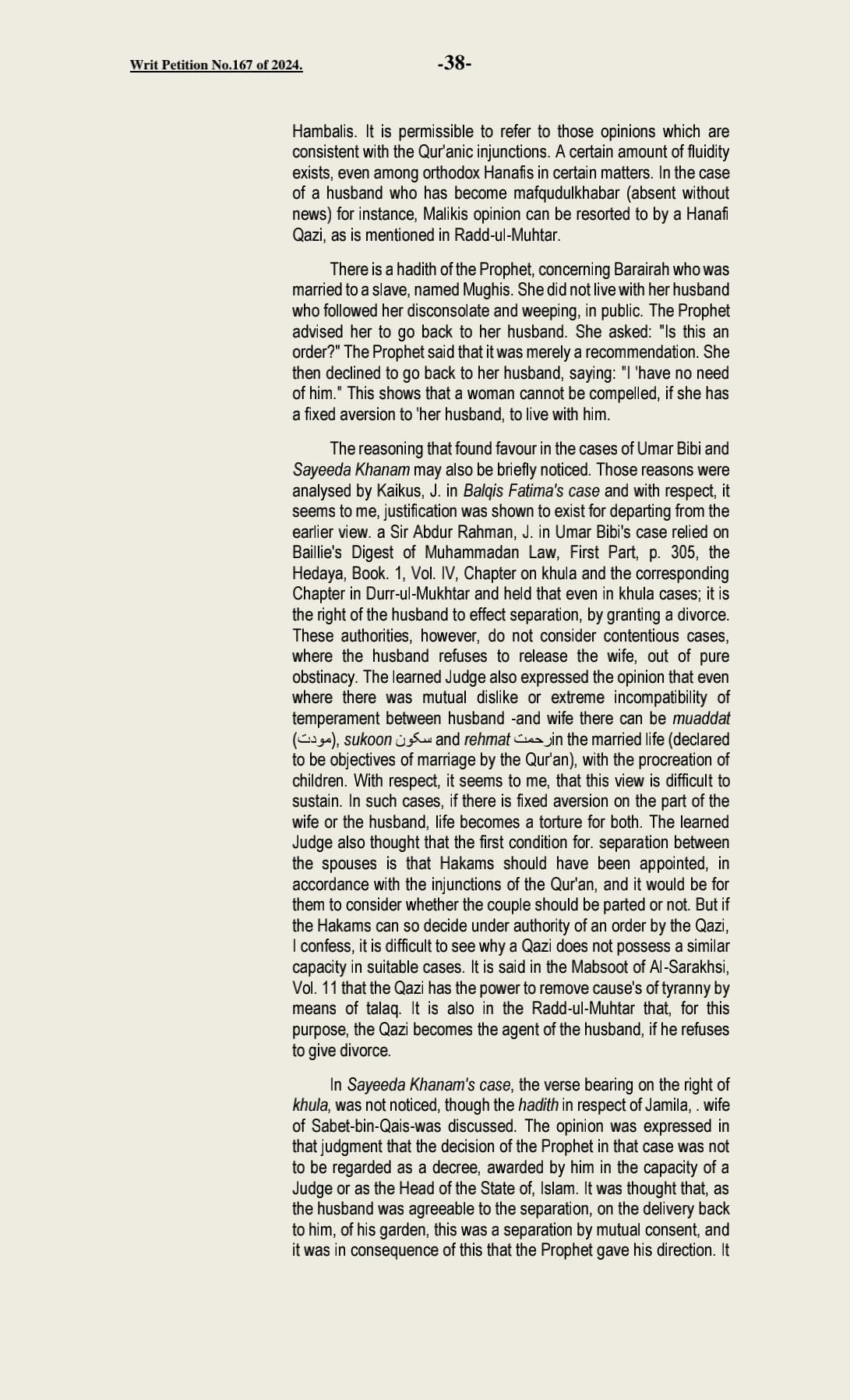
Secondly, to seek a decree of dissolution of marriage on the basis of Khula from the court of law, levelling of any allegation of maltreatment or mistreatment and misbehavior is not at all necessary. It is sufficient for her to state that she dislikes her husband to the extent that she cannot live with him as his wife within the limits prescribed by Allah for the court to proceed upon her demand. The wordings of these Ahadith are also very relevant that any kind of subjective feeling regarding disliking of a husband is a valid ground of dissolution of marriage on the basis of Khula, no additional ground or proof is required by the court to prolong the matter.
Thirdly, in addition to that, the statement which is referred to in the preceding paragraph, if woman wants Khula from her husband and she willfully returns the full amount of Mahar to her husband as Badal-e-Khula (بدل خلع), then the court should pass a decree of Khula without delay.
We would like to highlight this important point regarding Khula that it is not always necessary or binding on the woman to completely forego her dower for seeking dissolution of marriage on the basis of Khula. The amount of monetary compensation, which is to be paid by a woman, in a case of Khula cannot be greater than the dower amount received by her from her husband.
However, if a wife claims that she is forced to seek a decree of Khula because of her husband's ill-treatment or mistreatment, etc., the Court may reduce the amount of compensation if it finds the husband at fault after recording of evidence so much so that in severe cases, the Court may grant divorce in case of Khula to a wife without paying back any amount of Mahar at all. Many great Muslim jurists are of this opinion, like Imam Muhammad Hassan Al-Shaybani, Imam Abu Hanifa and Imam al-Kasani etc.
This point was also elaborated by this Court in our earlier judgment reported as PLD 2022 FSC 25 (Imran Anwar Khan v. Government of Punjab, etc.). We have already declared in our abovementioned judgment that under the Islamic law, as laid down in the Holy Quran and Sunnah, no Badl-e-Khula can be fixed by a statute as a mandatory amount for claiming Khula from the husband through a Court. In case a woman voluntarily surrenders the entire amount of dower she received at the time of her marriage in lieu of claiming Khula or Badl-e-Khula through a Court, then the Court has no option but to grant the decree of dissolution of marriage in her favour, after providing a chance to the spouses for reconciliation before passing of any decree of Khula. However, if a lady claims that she wants to seek Khula from her husband through a Court due to any maltreatment, mistreatment or ill-treatment, then the Court will decide the quantum of amount to be returned by the lady to the husband for seeking Khula based on the evidence and circumstances of the case after determining who is responsible for breakdown of the marriage.
The right of Khula granted to women by the Holy Quran and Sunnah is an absolute and a unique right, whereby a marriage can be dissolved through a Court at her will. A wife can get this right by showing her willingness to return the Mahar to her husband and in addition by simply stating in a court of law that she can no longer live with her husband as his wife within the prescribed limits set by the Almighty Allah as a reason for dissolution of marriage. This right of women cannot be denied by the court of law.
Section 10(5) was declared as against the injunctions of Islam by this Court through its judgment, dated 17.02.2022, in case reported as PLD 2022 FSC 25 (Imran Anwar Khan v. Government of Punjab, etc.), wherein this Court specifically mentioned the date of 01.05.2022 for becoming Section 10(5) of the Family Courts (Amendment) Act, 2015 as null and void under Article 203D(2)(b) of the Constitution of Islamic Republic of Pakistan
SHARIAT PETITION NO. 16/I OF 2022
Haji Saif-ur-Rahman Shaheen VERSUS Islamic Republic of Pakistan
Subscribe to:
Posts (Atom)
Powered by Blogger.
